


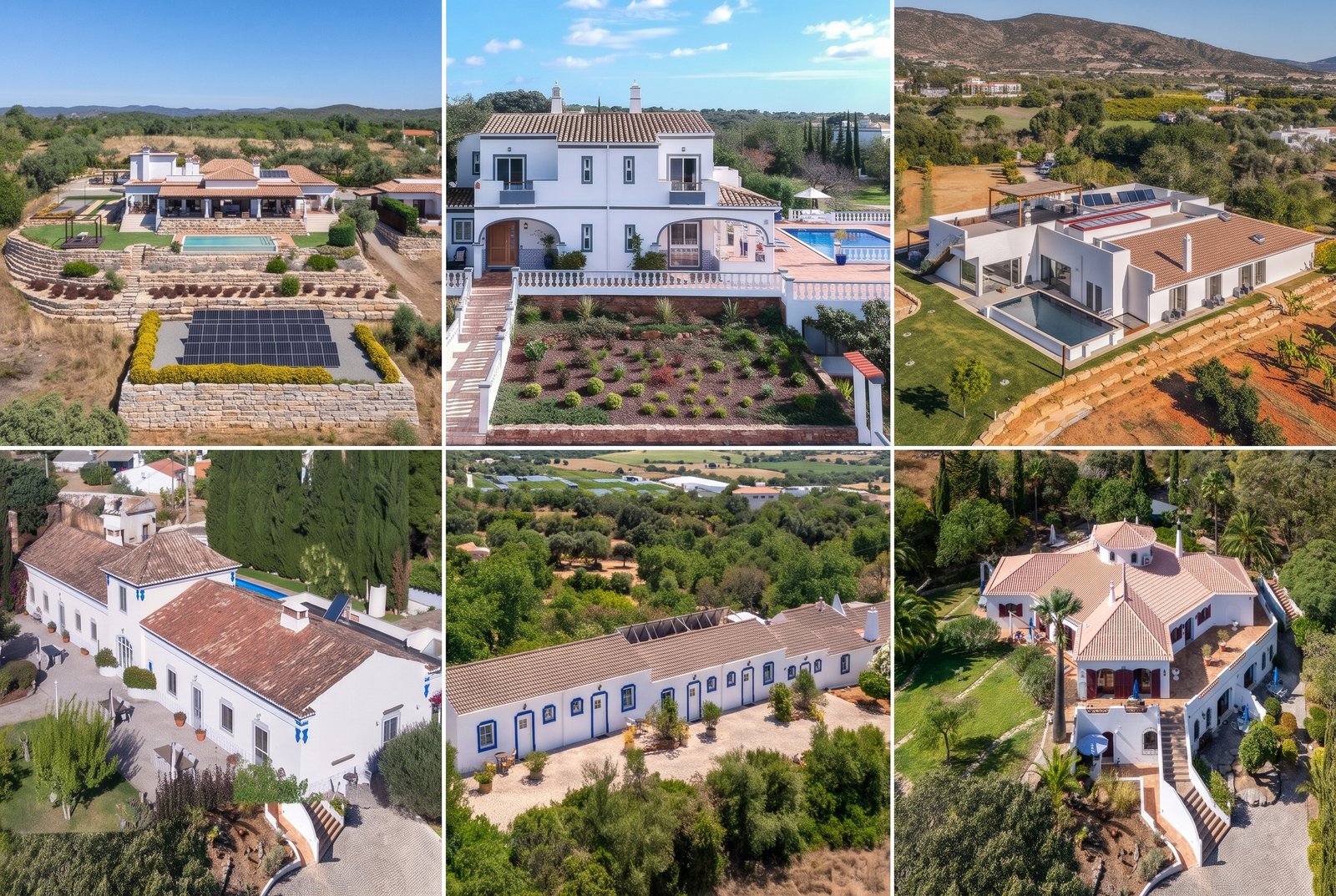
Opening a B&B in Portugal
AL vs TER: Which Tourism Licence Fits Your Algarve dream?
POV: you are dreaming of opening a Bed & Breakfast in Portugal but you have difficulties in seeing through all the regulations and obligations. Here is a recap of the most used licences for B&B’s.
If you want paying guests in Portugal, you need either an Alojamento Local (AL) registration or a licensed tourism enterprise such as Turismo em Espaço Rural (TER). To a guest they look alike. To the law and the tax office they are two very different businesses.
AL is the light, flexible route: register a house or apartment and start hosting. TER is a classified tourism enterprise, licensed like a small hotel and tied to the countryside. The choice affects how many guests you can take, what the building must look like, who inspects you and how much of your income is taxed.
Our B&B, Farmhouse of the Palms, actually started with an AL licence and we then switched to a TER license when extending in 2020. We currently operate an AL in Olhão (Casa da Bica Olhão), so we have lived under both regimes. Here is how they compare on limits, obligations and tax (as of November 2026).
I) What each licence actually is
Alojamento Local is a registration, not a licence in the strict sense, although we’ll continue using the word “license” in the remainder of this article. It is governed by Decreto-Lei 128/2014, last overhauled by Decreto-Lei 76/2024, in force since 1 November 2024. That reform reversed most of the Mais Habitação restrictions and handed control back to the municipalities. AL comes in four categories:
a) “Moradia”: a detached or semi-detached house or villa
b) “Apartamento”: an apartment or autonomous unit
c) “Estabelecimento de hospedagem”: a guesthouse, including hostels
d) “Quartos”: up to three rooms let inside the owner’s own home (owner’s residence)
Turismo em Espaço Rural is an empreendimento turístico, the same legal family as hotels and resorts. It falls under the tourism enterprise regime (RJET), Decreto-Lei 39/2008, with the minimum standards set by Portaria 937/2008. TER has three groups:
a) Casas de campo: houses in villages and rural areas whose design and materials fit the typical local architecture. Five or more run together in one village form a turismo de aldeia.
b) Agroturismo: accommodation on a working farm, where guests can take part in farm life.
c) Hotéis rurais: rural hotels, classified from 3 to 5 stars.
Casas de campo and agroturismo carry no star rating; their classification is simply the group name (Turismo de Portugal). Turismo de Habitação, for manor houses of historic value, typically in the centre of villages, is a separate category not covered here.
I.1 Alojamento Local
Capacity: at most 9 rooms and 27 guests, except hostels (no cap) and quartos (three rooms at most). Guests may not exceed two per bedroom, plus two in the living room for “moradias” and “apartments”. Extra beds are allowed up to 50% of the fixed beds, within the 27 limit.
The building: you need a valid licença de utilização (License of use or commonly habitation license) for housing or another use the municipality accepts as compatible. A missing licence or a house not fully legal is one of the most common reasons a registration fails.
Municipal rules: councils can draw zonas de contenção where new AL is restricted or frozen. Municipalities with more than 1,000 registered AL units had to decide whether to regulate the activity. Always check your council’s AL regulation before buying. For the time being, there are restrictions in Lisbon and Porto but more and more municipalities are publishing criteria for tracking the relative concentration of AL licences
Condominiums: prior approval from the other owners in an apartment block is no longer needed. But owners holding more than half of the building’s permilage (voting rights) can pass a reasoned objection, if proven and repeated disturbances occur, and ask the mayor to cancel your registration. The condominium can also charge you up to 30% extra on your annual quota for wear on common areas. In case the specific condominium rules prohibit apartments being used as AL, no license can be obtained.
I.2 Turismo em Espaço Rural
Location: the property must sit in espaço rural, meaning an area with a traditional link to farming or a rural landscape, and the municipal plan (PDM) must allow tourism use there.
The building: casas de campo and agroturismo are generally installed in existing buildings that respect the local vernacular. New construction is mainly a route for hotéis rurais.
Capacity: no cap.
Minimum standards: single rooms of at least 7 m² and doubles of at least 9 m², with one bathroom per three rooms in a casa de campo or per two units in agroturismo (Portaria 937/2008).
No AL-style restrictions: TER is not subject to AL contention zones or the AL condominium rules, because it is not an AL.
That last point matters in hot markets. Where a council freezes new AL, a rural property that qualifies as a casa de campo can still open legally, on a separate licensing track. This is because TER are commercial properties (like a shop or a restaurant) and not meant for habitation. So they are not competing with houses.
II) Obligations: getting started and staying compliant
An AL opens on a simple prior “notice”; a TER needs a licensed project, a tourism use permit and a formal classification before the first guest arrives.
II.1 Getting started
– AL is opened with a simple comunicação prévia com prazo on the government’s online portal (Balcão Único Eletrónico), a simple notice in layman’s terms You file your ID, the licence of the building, a statement of responsibility signed by yourself, proof of insurance and, where relevant, condominium documents.
This is very easy and straightforward.
The council can object within 60 days (or 90 days in a contention zone); if it doesn’t, you get your AL number. The council will usually carry out an inspection (vistoria) within that same 60- or 90-day window, and can still inspect at any time afterwards.
– TER follows the planning route (RJUE) like any building project, with an architect’s project, licensing or prior notice and then an autorização de utilização para fins turísticos (licence for use as a turistic building). It goes on the national tourism register (RNET). Expect months, not weeks.
II.2 Running the business
Both regimes share a core set of duties:
– Open an activity at the tax office (Category B) or run it through a company (Lda)
– Keep a physical and electronic (online) complaints book (livro de reclamações)
– Report every foreign guest to the immigration authority through the SIBA system; fines run from €100 to €2,000 per unreported guest
– Issue certified invoices and display the identification plaque
– Meet fire safety rules: extinguisher, fire blanket, first-aid kit, emergency information for AL with 10 or less guests. In case of more than 10 guests or in case of TER, the matter becomes more complicated: automatic fire detection and alarm, emergency lighting, signs marking exits and escape routes, floor plans showing the escape routes, etc. At the Farmhouse, next to the above measures, we were a fire hydrant with direct feeding from mains water network. You will need an experienced engineer to draw up the fire prevention and mitigation measures.
On top of that:
– AL must hold multi-risk and civil liability insurance; lacking this insurance is grounds for the municipality to cancel the registration. Keep your data on the online portal up to date. The council and ASAE (the food and economic safety authority) inspect.
– TER must keep meeting the Portaria 937/2008 standards for its group: room sizes, bathrooms, common areas and the services that go with its classification. Besides this, there are other rules that apply to TER (as a commercial business) and not to AL (housing): swimming pool security and maintenance, regular testing of quality of water, prevention of legionella outbreaks, etc.
III Fiscal implications
Under the IRS simplified regime, only 15% of TER income is taxed, against 35% for a typical AL house or apartment and 50% in a contention zone.
III.1a Income tax as a private person (IRS, simplified regime)
As a private individual, both activities are business income (Category B). In the simplified regime, the tax office applies a coefficient to your gross turnover and taxes only that part at your marginal rate:
– AL moradia or apartment: coefficient 0.35. The 65% presumed-expense deduction is conditional: you must document expenses of at least 15% of turnover, or the shortfall is added back.
– AL moradia or apartment in a contention zone: coefficient 0.50 (!)
– TER: as a tourism enterprise it counts as a hotel activity, coefficient 0.15. The AL carve-out in that same line does not apply to it.
– AL quartos and hospedagem: have been taxed at 0.15 in tax office rulings
On €40,000 of gross bookings, that means €14,000 taxable income for a standard AL, €20,000 taxable income in a contention zone and €6,000 taxable income for a TER.
III.1b The Category F option
AL moradias and apartments can choose, year by year, to be taxed as rental income (Category F) instead. That can pay off with very high documented costs. TER has no such option: it is always a business.
III.2 Operating through a company (Lda) changes the picture: profit is taxed under IRC on actual accounts, and the coefficients above no longer apply. A very interesting option exists when opting for a contabilidade simplificada: only 4% of turnover in case of TER is taxable.
III.3 VAT and other taxes
Accommodation is taxed at the reduced 6% rate on the mainland, for both AL and TER. Small operators can use the Article 53 exemption if annual turnover stays at or below €15,000 (only for residents); A TER of any real size will usually be VAT-registered, which also lets it recover VAT on renovation and running costs.
III.4 Capital gains and property taxes
– For individual owners, allocating a residential property to AL removes it from standard personal capital gains rules; if sold while active (or within 3 years of ceasing AL activity), gains are taxed as business income (95%) rather than enjoying the standard 50% personal real estate exclusion. Because TER properties are purpose-licensed commercial tourist assets from the outset, their sale is always treated as a commercial or corporate asset disposal (50%).
– The extraordinary AL contribution (CEAL) introduced by Mais Habitação was abolished retroactively in 2024 and was never collected.
– IMI is due as normal on both. Some municipalities also charge a tourist tax per night, which you collect from guests and that you pay onwards.
– Some services (like mains water) might increase in price because you are no longer considered a residential client.
Conclusion – Which one is right for you?
– Choose AL for a town house, apartment or villa you want to let, with low set-up costs and the option to switch back to private use or long-term rental. Just check the municipal regulation and, in an apartment block, the condominium rules before you buy.
– Choose TER for a rural property you want to run as a real hospitality business: more rooms, breakfast and services, a story rooted in the land. You will pay for it in time, architect’s fees and standards. In return you get a far lighter tax base, a higher capacity and freedom from AL contention zones.
Thinking of buying a property with a tourism licence, or converting one? Our real estate agency Signature Properties Solutions specializes in B&B’s businesses in Algarve. See https://www.signature-properties-solutions.com/bed–breakfast.
This article is general information as of November 2026, not legal or tax advice. Municipal rules and tax treatment depend on your situation; always confirm with a Portuguese lawyer and certified accountant before you commit.
